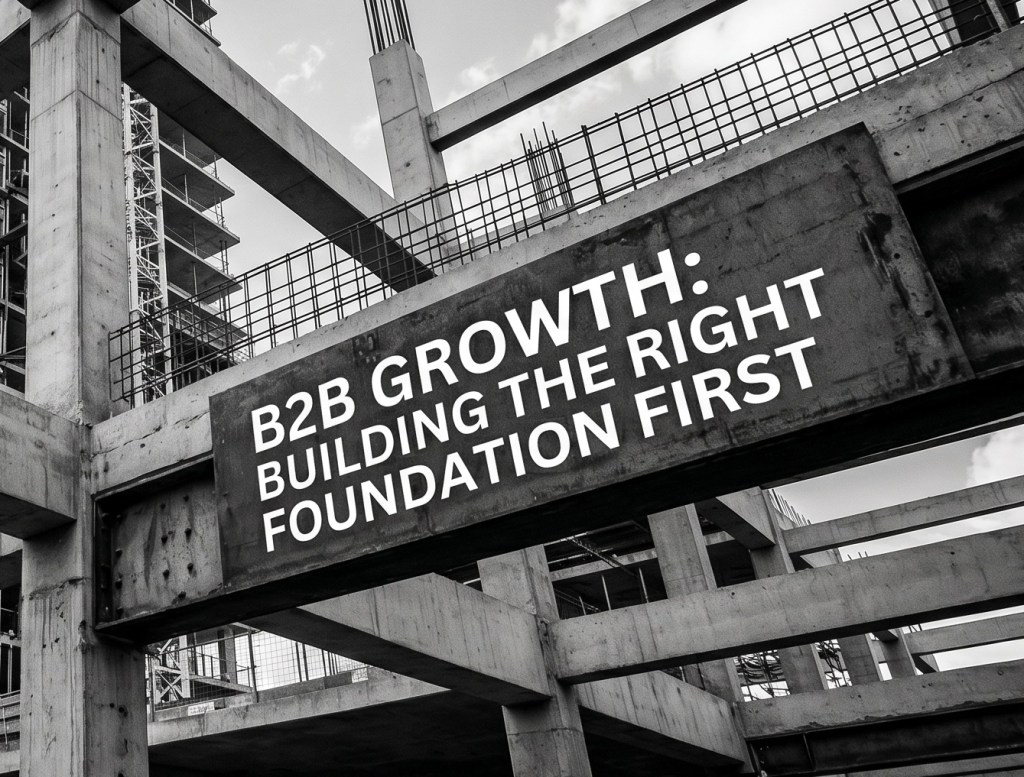
Why B2B Growth Campaigns Succeed: Building the Right Foundation First
A Real-World Perspective on Revitalizing a Legacy Financial Product
Sustainable B2B growth doesn’t begin with better ads: it begins with a stronger foundation.
The most effective campaigns are built on:
- Clear positioning
- Realistic expectations
- Tight alignment between marketing and operational delivery
When these elements are in place, investment in channels and creative becomes exponentially more effective.
I saw this play out when I took responsibility for a legacy lending product, over 25 years in market, with untapped growth potential.
Here’s what drove meaningful progress.
Start with Diagnosis, Not Tactics
High-performing teams resist the urge to jump straight into execution.
Instead of immediately launching campaigns, I focused on understanding the full system:
- Paid media performance
- Underwriting timelines
- Sales cycle dynamics
- Customer lifecycle behavior
That analysis created clarity and clarity drives better decisions.
Align Messaging with Reality
One key insight reshaped the entire strategy:
The product was positioned as a 90-day funding solution.
Operationally, it averaged 155 days.
Bridging that gap became the priority.
When marketing reflects reality:
- Trust increases
- Sales conversations improve
- Long-term brand equity strengthens
The most effective optimization wasn’t conversion tactics; it was alignment.
Shift from Products to Outcomes
Initially, the business emphasized individual offerings:
- SMB loans
- Asset-based lending
- Specialized financing products
We reframed the narrative around a unified concept: Business Lending
Why this worked:
- Customers think in terms of outcomes, not products
- It clarified the brand’s role in the market
- It reduced friction across the funnel
Clients weren’t seeking “ABL.” They were seeking:
- Reliable cash flow
- Stability in uncertainty
- Pathways to growth
Focusing on outcomes made the value proposition immediately clearer.
Strategic Segmentation in a Regulated Environment
In financial services, precision matters, and compliance limits traditional targeting.
We built segmentation using:
- Firmographics (revenue, industry, company size)
- Role-based targeting (CFOs, controllers, presidents)
- Psychographics (financial pressures, decision triggers)
Two audiences proved especially impactful:
1. Financial Decision-Makers
Focused on liquidity, restructuring, and growth strategy
2. Referral Networks
Bankers, brokers, and advisors influencing deal flow
Recognizing both groups strengthened pipeline quality and consistency.
A Practical Multi-Channel Approach
Rather than relying on a single channel, we built a structured, full-funnel presence:
Awareness
Thought leadership, video, paid social
Consideration
Industry content, email nurture, webinars
Conversion
Targeted offers, guides, sales enablement
Engagement
Ongoing communication, direct outreach
This approach ensured consistent visibility and reinforced credibility over time.
Clear Messaging Drives Results
With the foundation in place, messaging became simpler and more effective:
- “We fund deals other banks won’t.”
- “Put your assets to work.”
- “You’re not just a number.”
Direct, outcome-oriented language resonated more than technical detail.
Measuring Success Beyond Surface Metrics
While the initial goal was three funded deals and we achieved two, the broader impact was significant:
- Increased volume of qualified leads
- Strong return on marketing investment
- Improved lead quality through better intake design
- Implementation of scalable lead scoring
The result: a stronger, more predictable growth engine.
Systems Enable Sustainable Growth
The most valuable outcome wasn’t a single campaign. It was the infrastructure built around it:
- Reliable attribution and tracking
- CRM integration and automation
- Improved data quality and retargeting
- Ongoing testing and personalization
- Repeatable campaign frameworks
Campaigns create momentum. Systems sustain it.
Key Takeaways for B2B Leaders
- Alignment builds trust
Ensure your operations and messaging reinforce each other - Outcomes resonate more than products
Speak to what customers achieve, not what you offer - Segmentation sharpens performance
Precision improves both efficiency and impact - Consistency across channels matters
Trust develops over multiple interactions - Systems drive long-term results
Scalable processes outperform one-off efforts
Final Thought
Strong marketing doesn’t just promote a business, it reflects how well the business itself is operating.
The real shift is moving from asking:
“What campaign should we run?”
To asking:
“What foundation will support the growth we’re trying to achieve?”
That’s where durable, scalable success begins.
 Noah Cisneros
Leave a comment