
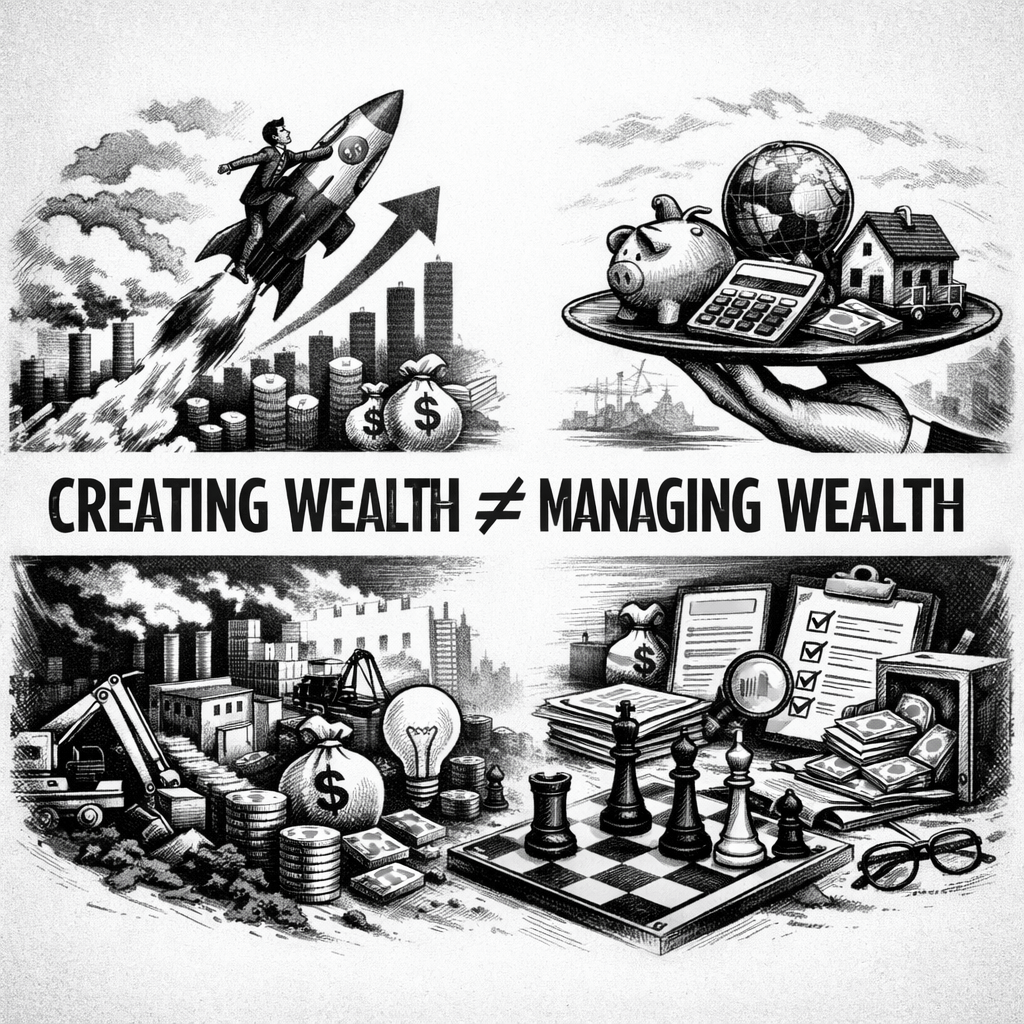
Creating Wealth ≠ Managing Wealth
I’ve recently read the book A Simple Path to Wealth, by J.L.Collins. It is a fantastic book with real-world practical advice.
It caused me to reflect on the difference between managing money and creating income. So often, financial literacy focuses simply on categories of money: investing, saving, etc.
However, the way that J.L.Collins includes ways to make money in his book about managing money highlights the important distinction between the two. Understanding this can help support optimal money management and wealth creation.
Creating Wealth:
The formula I’ve extracted is the following:
Valued Skills + Efficient Time + Play the Game = Income Generation
Valued Skills:
Jim Rohn said, “You don’t get paid for your time, you get paid for the value you bring to that time.”
Said another way, the marketplace pays you for your value, not your time.
There are so many ways you can provide value to so many people.
Your worth in the marketplace is not determined by your worth as a human being or individual. Your worth in the marketplace is determined by the value your skills bring to the marketplace.
Too often, people will go to college to get a worthless degree and are surprised that the market does not value them.
I am a firm supporter and believer in traditional academic education; that being said, the goal should be to build value in the marketplace, not to establish self-esteem.
During my undergraduate Professional Sales course, I had a peer make the following comment: “I feel like anyone with a college degree should be paid at least $40k a year at any job they get upon graduation.”
The professor looked at the student and said, “That’s cool, I have feelings too. No business cares about what I ‘feel’ I should be paid.”
The marketplace determines your value to the marketplace. Your value in the marketplace determines your income. It’s as simple as that.
So if your skillset is not generating the income you need to reach your goals (notice how I did not say if you are not earning what you deserve), then enhance and develop your skills to be literally *worth* more to the market.
Efficient Time:
Understand who you are and how you manage yourself. This makes managing your time easy.
Real income is not generated by simply clocking time. It is generated by providing value at scale.
That being said, how you manage your time is key to being a productive and valuable member of society. If this is something you’re looking to optimize, I recommend this video to you by Alex Hormozi.
The real question here is, how do you create more value with the same amount of time?
Play the Game:
At the end of the day, money is a game. Luck is a factor. But luck is not the factor.
Business and wealth are a game: a game oflife and death. About 16.2% of male suicides involve finances. That is a very depressing thought, but it highlights how seriously finances impact our lives.
Understanding the way the system works can help us be prepared for how the system will impact us.
Here are three rules I have benefited from when playing the game of money:
- Money Magnifies: It does not corrupt or change: It simply intensifies who you are.
- Give yourself as many opportunities to be lucky as you can: Luck plays a role, but it is not the differentiator. You become the differentiator when you start looking for opportunities to be lucky.
- You are what you do, not what you say you will do: Your reputation and how you hold yourself accountable will determine the momentum you sustain.
I’ve been a big fan of Patrick Bet-David for many years; his 20 rules of the money game are worth the 20 minutes used to watch this video.
Managing Wealth:
Spend + Save + Invest = Wealth Management
In his book, Collins explains how he started his financial journey by saving 50% of his income. Forcing himself to live off of 50% of his income built the muscles and habits he needed to optimize his spending, saving, and investing as he continued to generate income.
Spend:
Being intentional with how you spend your money can be the hardest aspect of money management, but it determines if you are successful or not.
The reason I break out managing wealth from creating wealth is that you can create enormous amounts of wealth and still be broke.
You can work really hard, provide lots of value, generate massive income, and have nothing at the end of the day. Ever feel like nothing is working?
Often, as people earn more and more throughout their careers, their lifestyle will become more and more expensive.
This leads to someone making $100k a year with the same paycheck-to-paycheck lifestyle because the expenses increase.
Being intentional about your spending means choosing what is and is not worth spending your money. It means live within your means. Budget your income.
A Starbucks coffee won’t be the difference between having wealth and keeping wealth, but the habit of justifying an impulsive small expense with no thought will be.
I developed a budget template as part of a passion project that can help you if you need somewhere to start.
Save:
Scott Galloway says, “It’s not about the money you make, but the money you keep.”
Being intentional about when and how you spend your money naturally leads you to being intentional about not spending money.
Be intentional with your savings. Have emergency savings and spend savings. Perhaps you can set up a Direct Deposit into a High-Yield Savings account to automatically send money to your future self while earning an interest rate on it.
A penny saved may not be a penny earned due to inflation, but the muscle you develop from saving, future accumulated savings, will empower you to be financially free.
Invest:
When it comes to risk, it is about frequency, not volume.
It is better to take more risks, not bigger risks.
Thoughts on where to start:
- Active investing is risky and behaves much more like gambling. Daytrading takes this approach to the next level, acting like sports betting. It is addictive, it is unlikely to produce profitable results over time, and it requires taking bigger risks. This approach focuses on risk volume, not frequency.
- Index funds are an incredible way to maximize long-term ROI on investing, without the gamble of active management. The essential mechanics focus on taking lots of small risks. This approach focuses on risk frequency, not volume.
- Whether you are an active investor or invest in index funds, focusing on business value, not hype, can prevent speculative decision-making. I’ve written about this in a prior article for this newsletter (see:https://noahcisneros.com/2026/01/22/decisions-create-systems/).
I also recommend listening to this interview of J.L. Collins if you want to learn more about value investing.
Summary:
Regardless of where you are in your own personal financial journey, I encourage you to evaluate your position by using these two formulas:
How are you creating wealth?
Valued Skills + Efficient Time + Play the Game = Income Generation
How are you managing that wealth?
Spend + Save + Invest = Wealth Management
2.5.26
By Noah Cisneros
Disclaimer:
This article is not sponsored or approved by any financial institution that I am associated with. I am NOT a certified personal financial advisor. I am NOT a professional investor. This article is purely educational to provide helpful ideas to improve life. Please use the tools within your reach to personally make any and all decisions for your finances.
 Noah Cisneros