Using HubSpot to Drive Measurable Business Growth
Marketing software doesn’t make you effective. Strategy does.
HubSpot isn’t valuable because it sends emails or builds landing pages. It’s valuable when it connects strategy, execution, and measurable business results.
That’s how I use HubSpot Marketing Hub: as an operating system for growth, not a collection of tools.
HubSpot Is Infrastructure, Not a Tactic
Many marketers only use HubSpot tactically: emails, pages, automation after launch.
I start earlier.
Before building anything, I define:
- The business objective
- The customer decision journey
- The metrics leadership cares about
Then I configure HubSpot to support the strategy.
Used this way, HubSpot stops being “marketing software” and becomes infrastructure executives rely on to understand what’s working, what’s not working, and why.
Campaigns Built for Cohesion, Not Noise
Inside HubSpot Marketing Hub, I’m obsessive about cohesion.
Every campaign I build is designed as a connected experience across landing pages, forms, calls-to-action, email, automation, and reporting. I believe that almost nothing should exist in isolation.
This discipline matters.
Cohesive campaigns reduce friction, improve conversion efficiency, and make attribution cleaner.
This supports better decisions when reviewing and analyzing data.
I have used HubSpot’s landing page + email abilities to create a consistent message and experience for business prospects.
Email is anything but dead and HubSpot makes it easy to insert dynamic modules to create a personalized experience:
Disclaimer: No financial offerings or any TAB Bank products are offered or promoted on this site. Noah Cisneros is a paid employee of TAB Bank as of 12.16.25. No claims or suggestions on this site reflect TAB Bank’s stance in any way. No financial services are offered through or on this site.
Authentic Automation
Marketing automation gets a bad reputation because it’s often used to replace thinking instead of scaling.
That’s not how I use HubSpot.
I rely on workflows to:
- Nurture leads based on real behavioral signals
- Maintain clean lifecycle stages and data hygiene
- Improve internal communication through timely notifications
- Vet lead quality
- Set lifecycle journey stages
- Distribute MQL & SQL opportunities to the appropriate team
Automation should make marketing simpler, cleaner, not messier.
Please see this example of a workflow I built to review lead quality, organize the contact based on filter criteria, and then distribute the lead to the appropriate sales team.
Measurement That Ties Back to the Balance Sheet
Open rates and click-through rates are useful, but they’re not the finish line. I use HubSpot reporting to connect marketing activity to outcomes that matter:
- Conversion efficiency
- Cost-per-acquisition
- Revenue and deposit impact
- Drop-off rates per stage of the buying cycle
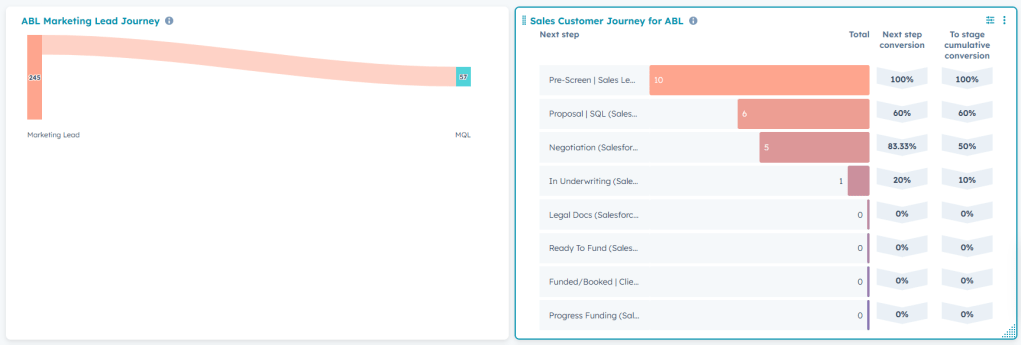
If marketing can’t explain its economic impact, it doesn’t claim more budget. Here is an example of what a funnel report in HubSpot Marketing Hub can look like:
My Approach
What sets my approach apart is simple:
- I treat HubSpot as growth infrastructure
- I align inbound marketing with business strategy
- I use automation responsibly and intentionally
- I measure success in outcomes, not activity
Marketing doesn’t need more tools.
It needs better planning for its tactical execution.


Works Cited
HubSpot Academy. HubSpot Marketing Hub Software Certification. HubSpot Academy.
HubSpot. Marketing Hub Overview. HubSpot.
My certification: https://app.hubspot.com/academy/achievements/62gjw715/en/1/noah-cisneros/hubspot-marketing-hub-software
 Noah Cisneros
Leave a comment